Knowledge as Power
She left school at twelve and enrolled at the Madras Bar at thirty-three. The two decades in between are the most under-told part of her life, and the part that explains everything after it.
Folio I
An education taken out of order
Most public careers of her generation begin with a degree. Hers begins with the refusal of one. She left English-medium schooling at about twelve in 1921–22, and for the next decade her education was entirely practical: Hindi, teaching, organising, the running of a small school, the management of an exhibition, and then prison.
She began collecting formal qualifications only in her twenties, after the civil disobedience arrests. She took a B.A. and then an M.A. in political science from Andhra University, and afterwards read law at Madras University, taking her law degree in 1942. Some accounts state that she completed the M.A. while imprisoned; others place the study after her release. The sources genuinely differ, and this site does not resolve it.
The sequence matters more than the dates. She did not go from school to university to the bar to public life. She went from public life back into school, and then to the bar, because she had concluded that the work in front of her required technical knowledge she did not yet possess.
Folio II
Why law, specifically
By her own later account, she took up law in order to be able to give poor women free legal aid. That is a modest and very specific reason, and it fits everything else she did. She had spent a decade watching women whose problems — marriage, maintenance, property, custody, destitution — were legal problems that they had no means of pursuing. A movement could not fix that. A lawyer could, one case at a time; a law could, permanently.
She enrolled as an advocate and practised at the Madras High Court from 1942. Her practice was relatively brief: within four years she was elected to the Constituent Assembly, and public work absorbed her from then on.
No specific case, client or judgment from Durgabai Deshmukh's practice is described on this site, because no reliable record of her case work was available in compiling it. Popular accounts sometimes attribute landmark litigation to her; that attribution is not supported and is not repeated here. What is documented is her enrolment, her court, and the use she made of legal training afterwards.
Left schoolc. 1921–22, aged about twelve
DegreesB.A. and M.A., political science, Andhra University
LawLaw degree, Madras University, 1942
PracticeAdvocate, Madras High Court, from 1942
DisputedWhether the M.A. was completed inside prison or after release
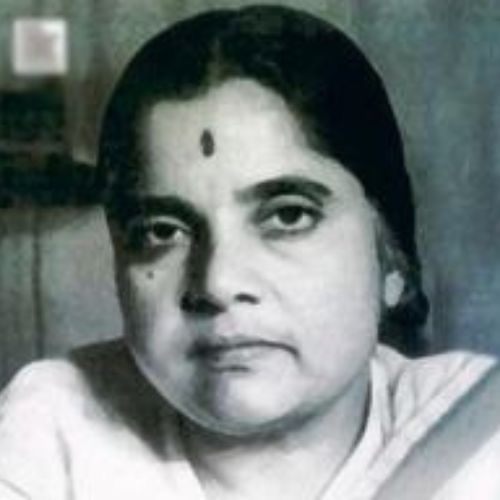
The lawyer's argument
Her legal mind is not something we have to reconstruct. It is on the record, in her own words, in the Constituent Assembly.
“A right without an expeditious and effective remedy serves no purpose at all, nor is it worth the paper on which it is written.”G. Durgabai, on the right to constitutional remedies, Constituent Assembly of India Debates, Vol. VII, 9 December 1948, pp. 937–938
That sentence is the whole of her method. A guarantee is a piece of paper; what makes it real is a procedure, a forum, and someone who can afford to use them. It is the same instinct that took her from protest to schools, and from schools to a national welfare board.
Question → Law → Access → Justice
Her working chain, set out as she seems to have understood it. Each step is worthless without the one after it — which is precisely the point she made to the Assembly.
- QuestionSomeone has a grievance — a marriage, a wage, a child, a piece of land, a denial of entry. At this stage it is only a private misfortune.
- LawThe grievance is named in a rule that binds the state and other people. Now it is a right rather than a hardship.
- AccessThere is a court that will hear it, a procedure that is not ruinous, and someone able to argue it. Without this step the right is, in her words, not worth the paper it is written on.
- JusticeThe remedy is actually delivered — and, if the problem is general rather than individual, an institution exists to keep delivering it.
Education as a public question
Her own late education gave her an unusually concrete view of what schooling is for. She did not treat it as cultivation. She treated it as capability: the ability to earn, to read a document, to know what one is entitled to, and to be taken seriously in a room.
That view runs straight through the rest of her life. The Hindi school at Kakinada in 1922, the classes that grew into the Andhra Mahila Sabha in 1937, the Andhra Education Society founded in Delhi on 5 June 1948 for Telugu-speaking children, the vocational training she insisted accompany academic teaching, and the National Committee on Women's Education she chaired in 1958–59 are all the same argument, restated at larger and larger scale.
It is also why she is difficult to file. A freedom fighter who becomes a lawyer who becomes a legislator who becomes a builder of schools and hospitals looks like four careers. It is one career, pursued through whatever instrument was available at the time.